The State of Adventure in 2026: My Talk at Expedition Finse
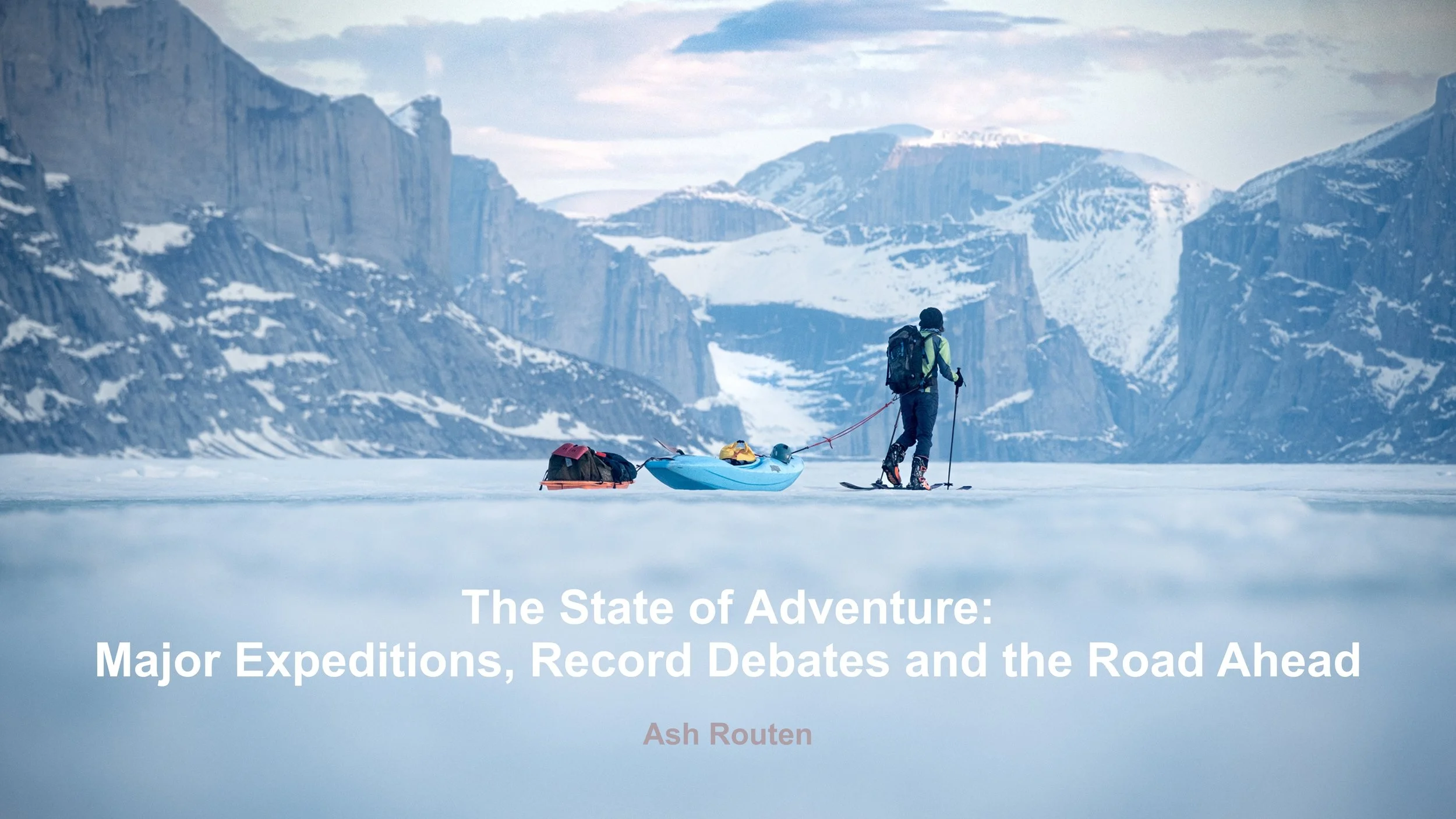
Photo: Erik Boomer
In February, I travelled to Finse, high in the mountains of southwestern Norway, to attend and speak at Expedition Finse, an adventure festival now in its fifteenth year. Hosted by a local hotel in collaboration with the Norwegian chapter of The Explorers Club, the event brings together explorers, storytellers, and adventure enthusiasts from around the world. I was invited to deliver a 45-minute talk on the current state of adventure. What follows is a transcript of that talk, interwoven with the slides I used along the way.
I’m especially happy to be here because, most of the time, I’m not in rooms like this. I’m usually sitting alone at a desk, writing about expeditions happening all over the world. My interaction with the adventure community is normally through emails, comment sections, or social media. So it’s genuinely nice to be able to share some of these thoughts face to face, with a live audience of people who actually care about this stuff.
So there are going to be three parts to this talk, not necessarily all the same length.
I want to start by looking at what actually makes an expedition noteworthy in the modern context of adventure. Then I’ll give a recent example of a standout expedition from last year, before moving on to some of the issues we have in the expedition community around record claims and media reporting.
The next part is a bit more optimistic and solutions-focused, looking at what might still be left to do in terms of interesting, polar-style expeditions, and I’ll share a few examples to hopefully whet your appetite.
And finally, I’ll briefly close with where I think the cutting edge of adventure is heading, particularly when it comes to multi-discipline journeys and expeditions.
Part 1 – The Problem
I’m going to make a guess about this room.
Most of you have done or are planning a journey that means a huge amount to you personally.
And some of you have probably wondered, quietly: is this something worth sharing? Is it actually noteworthy?
That tension sits at the heart of my work, and it’s getting harder to navigate.
When I was preparing this talk, I contacted Antarctic Logistics and Expeditions – ALE – who are the main expedition logistics provider in Antarctica. I asked them a simple question:
How many people have skied to the South Pole in the last ten years, using either the Hercules Inlet or the Messner start routes?
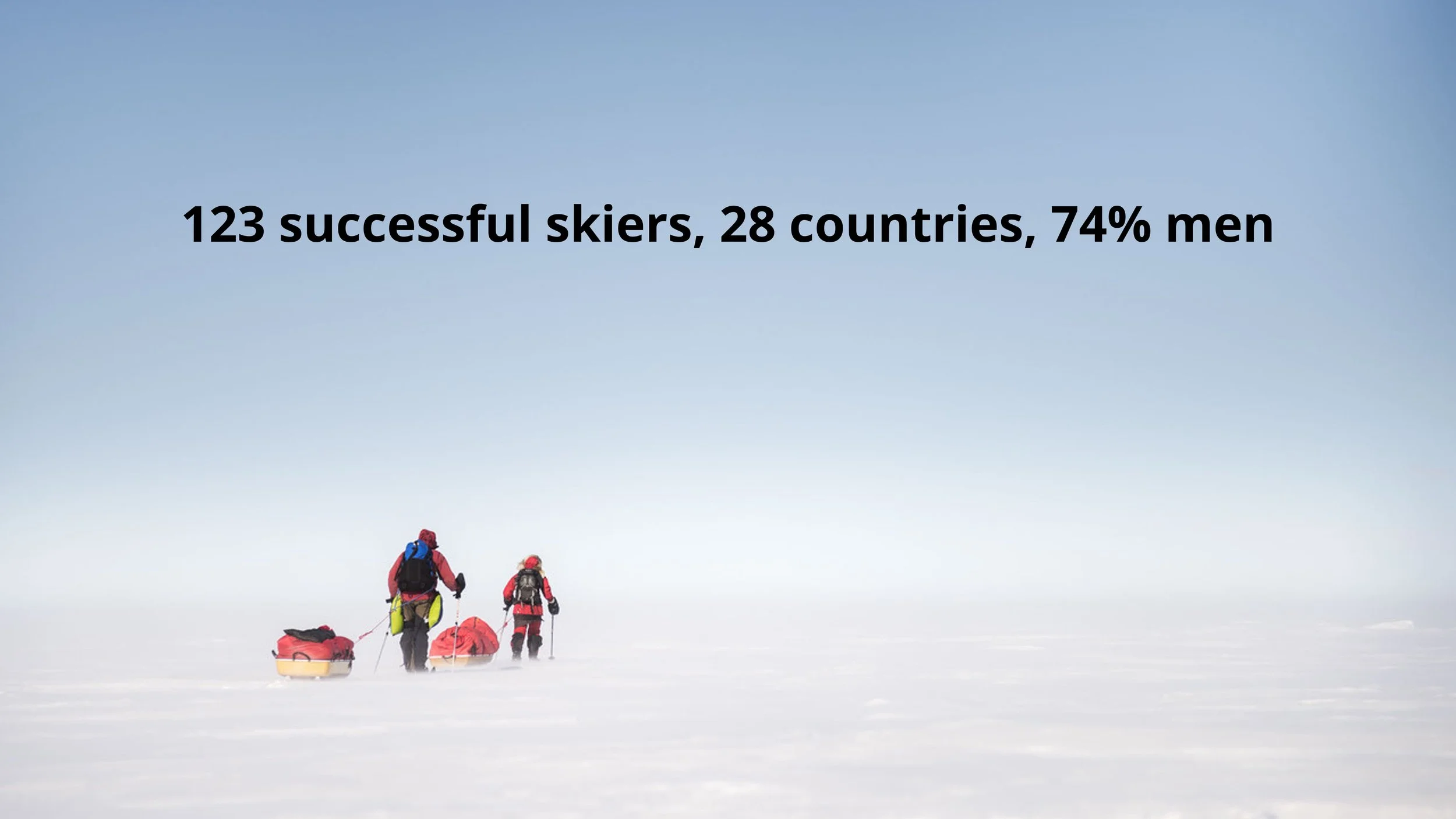
Overall 165 people have skied to the south pole via all routes, and 123 successfully by the Hercules Inlet or Messner Start, with 20 being unsuccessful. Men dominate, but there’s a growing proportion of women, and a much wider spread of nationalities – 28 different countries are represented. And that’s obviously a good thing. It shows that these kinds of adventures are becoming more accessible, more inclusive, and less limited to a very small group of people.
But it also raises an awkward question.
With greater numbers, are these expeditions still really unique anymore?
What was once exploration and adventure has, in many cases, arguably become sport. And that leads to an uncomfortable follow-up for someone like me:
Should I even still be reporting on them?
I think we’ve reached a point where we need to start separating personal adventure from noteworthy or cutting-edge expeditions.
There are journeys that are incredible personal achievements – life-changing, meaningful to the individual, difficult – but that maybe don’t deserve wide media coverage, or a place in the adventure history books.
A very simple example:
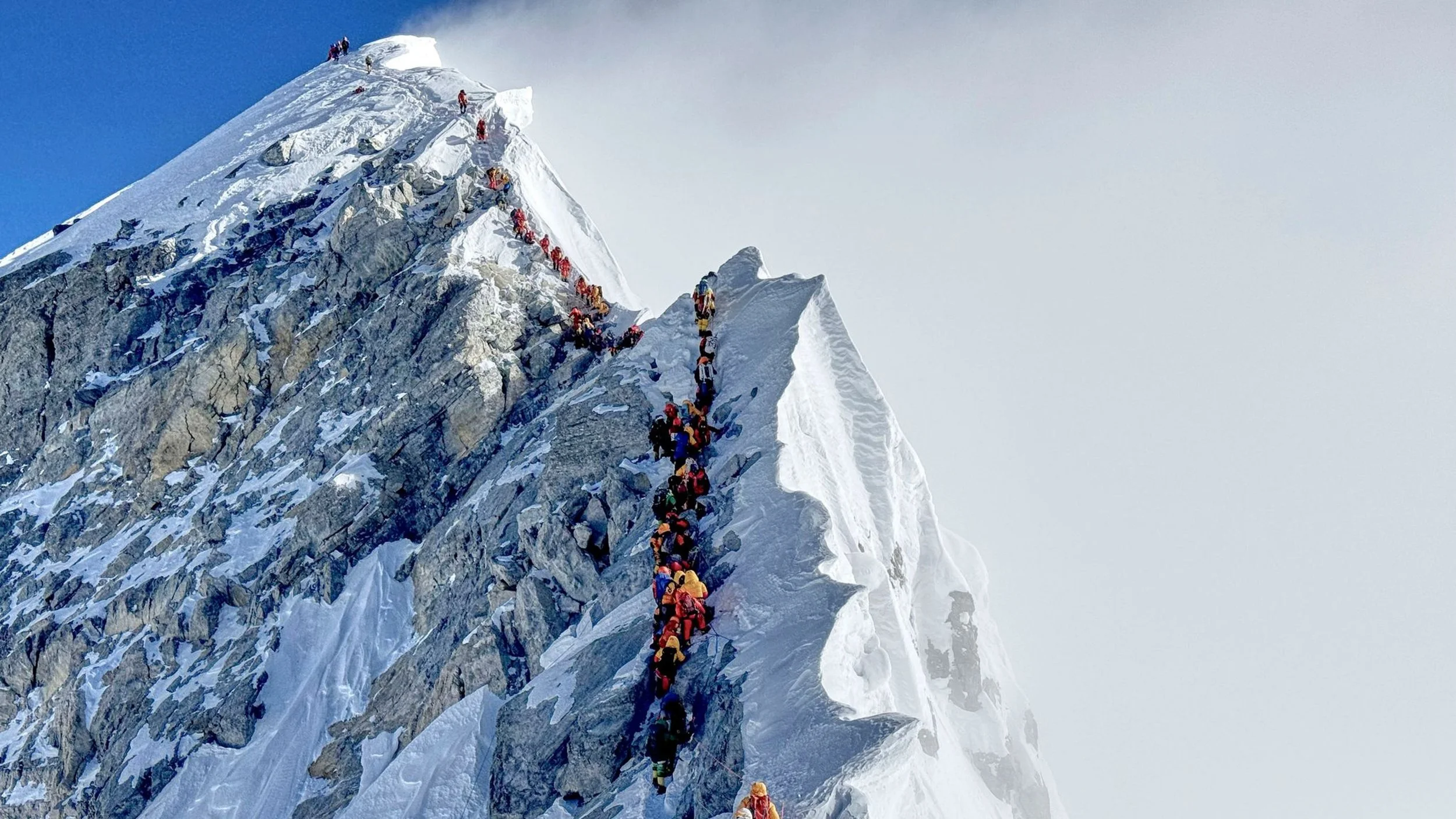
Climbing Everest via the South Col on a guided expedition is a huge personal achievement. It’s physically demanding, mentally tough, and something most people will never do. But in terms of mountaineering history, it’s not even a footnote. It doesn’t push standards, change what’s possible, or add anything new to the story of exploratory climbing.
So then the obvious question is:
What actually makes an expedition noteworthy?
What makes something worth reporting on, worth documenting, and maybe even worth recording in the history of adventure?
There’s no clear answer. It’s subjective, and there’s no global rulebook. But as a writer, I’ve ended up with a few guiding principles that I use when I decide whether a journey is genuinely interesting and cutting edge.
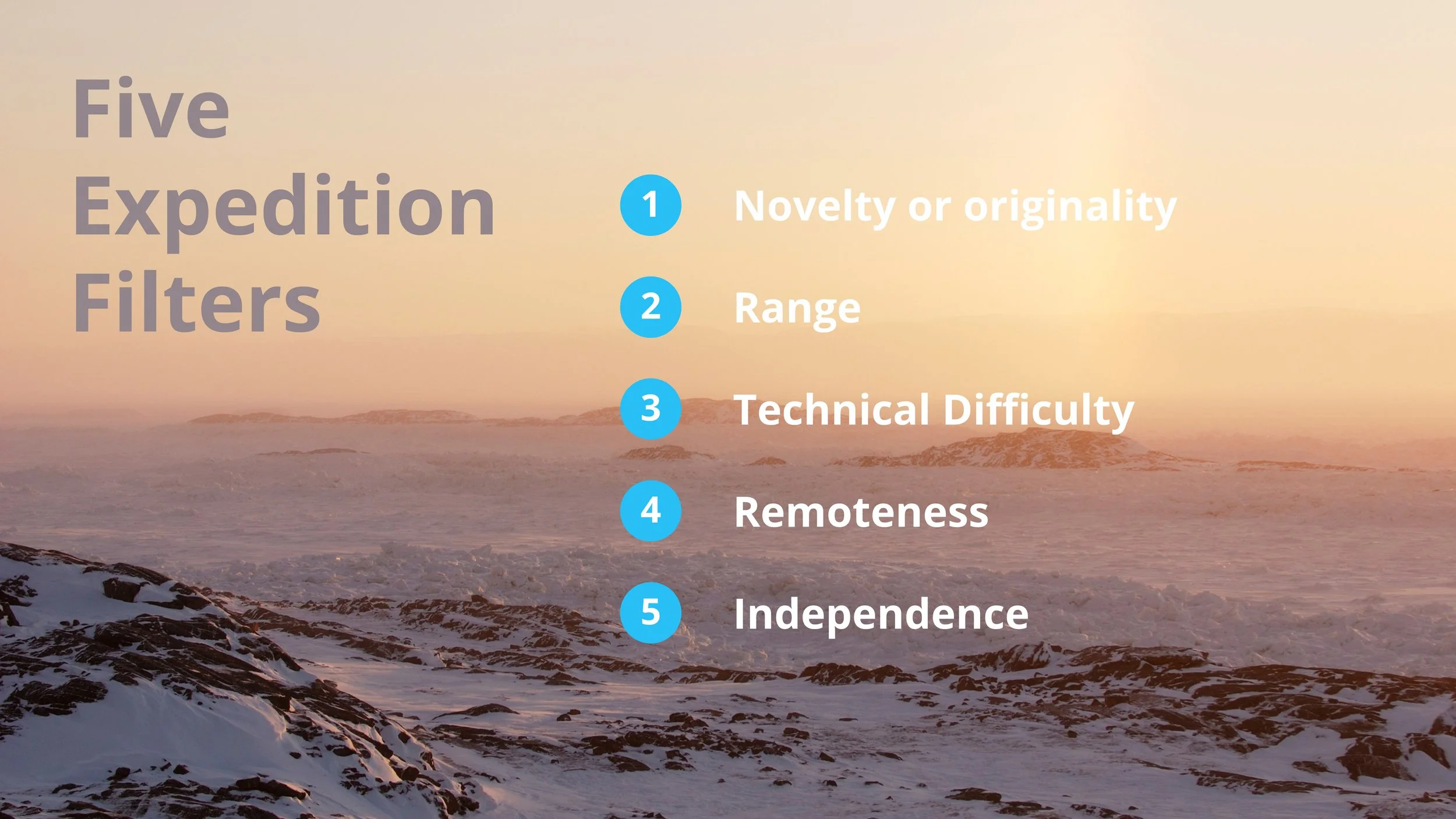
Here’s my five filters
The first one is novelty, or originality.
I’m much more interested in journeys that follow routes that are rarely travelled – or not travelled at all. That might mean a new line, a bold variation, or just the road less taken. In polar terms, that might mean skipping the usual Antarctic sled routes entirely, and instead imagining a long, remote sled journey through somewhere like the Northwest Territories, or even parts of the Northwest Passage.
The second thing is range.
Distance matters – but only in context.
A 1,000-kilometre unsupported hike in the Yukon is a serious and difficult undertaking, a 100 mile hike less so because of the obvious reduced difficulty of carrying less.
An 8,000-kilometre road cycle across Europe is impressive, but relatively straightforward.
A 1,000-kilometre ride through the dirt backroads of the Tibetan Plateau is a completely different level of challenge.
Then there’s technical difficulty.
This is where things really start to get interesting. Mixed alpine climbing, sea ice and glacier travel, open-ocean kayaking – environments where skill, risk, and constant decision-making are unavoidable. For me, the more technically demanding a journey is, the more it says about the team, their competence, and the quality of the expedition itself.
And finally, there are two other factors that I think matter too:
Remoteness, and independence.
True remoteness means being days – not hours – from help or habitation. The Brooks Range in Alaska scores much higher here than the Swiss Alps ever will.
And ideally, the journey is unguided. The team plans it, organises it, and executes it themselves. Ownership of the expedition really matters. When you control the decisions, the risk, and the logistics, you also own the outcome – for better or worse.
Taken together that list is for me where adventure becomes something more than just a personal challenge. That’s where it starts to become genuinely interesting.
A useful example of what I mean comes from one of the top ten ExplorersWeb expeditions of 2025: the first unsupported north–south crossing of Ellesmere Island in the Canadian High Arctic.
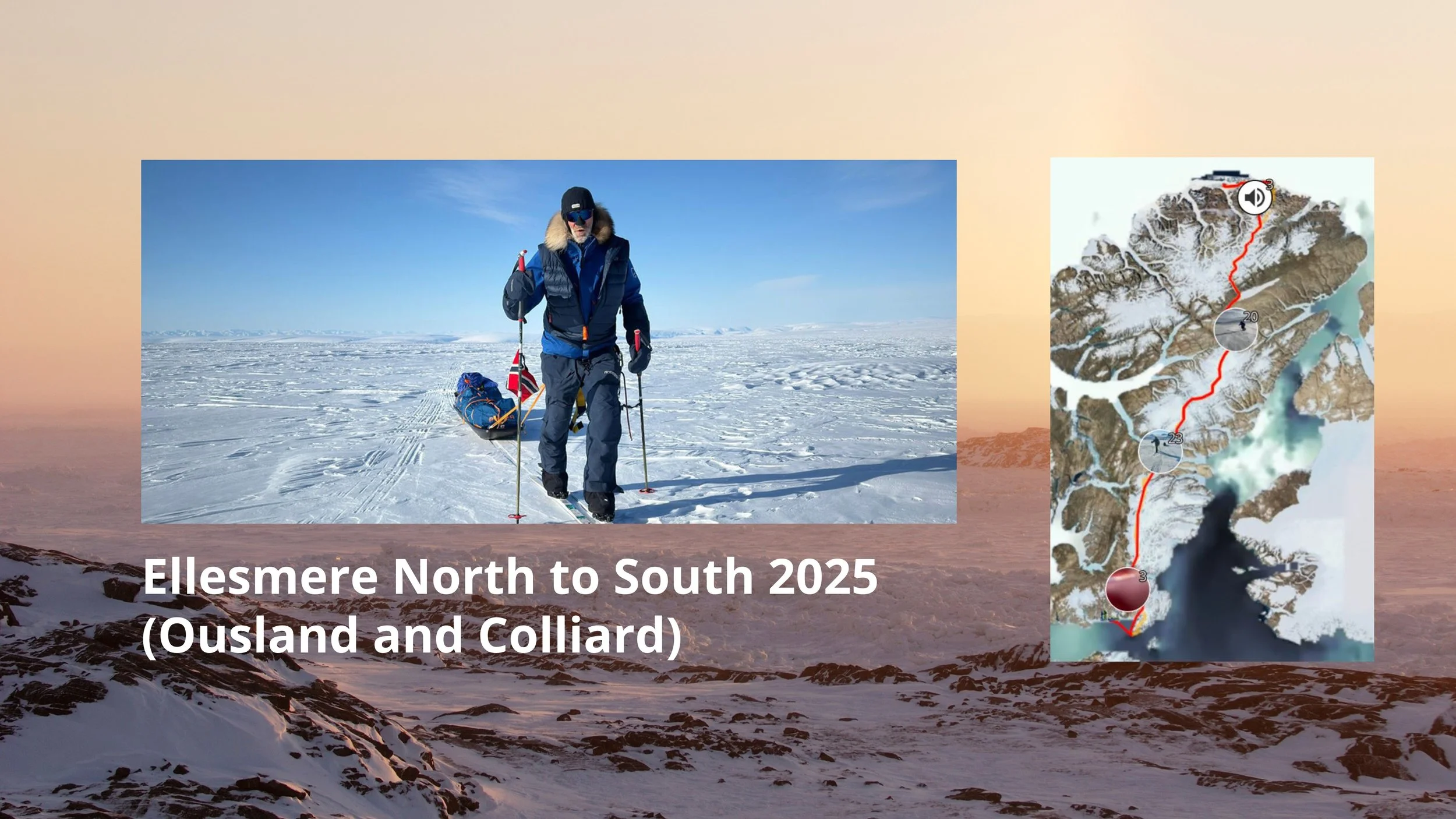
The two experienced polar travellers, Borge Ousland and Vincent Colliard, travelled roughly 1,100 kilometres over 49 days, skiing the length of the island entirely under their own power, carrying everything they needed from the start.
In terms of originality, it was the first time the island had been crossed this way without resupply. It wasn’t repeating a standard route, but doing something that simply hadn’t been done before in that style.
The range matters because of the setting. Eleven hundred kilometres in the High Arctic, over ice caps and glaciated terrain, is a very different proposition from the same distance somewhere more benign, like arguably the Hercules Inlet route in Antarctica.
There was also technical complexity or difficulty. This wasn’t just steady plateau skiing. They had to deal with awkward passes, multiple crevassed ice caps and even some sea ice at the start, and of course at one point Vincent took a crevasse fall, and they encountered a polar bear early on in the trip.
And then there’s remoteness. Ellesmere is about as far from infrastructure as it gets outside of Antarctica.
It doesn’t mean this kind of expedition is “better” than others. But it does illustrate the sort of journeys that tend to add something genuinely new to the broader story of exploration, rather than just repeating something that’s already well established.
Where I start to struggle with all of this is when mainstream media can’t really tell the difference between an expedition like the Ellesmere crossing, and something I’d put more in the category of a personal challenge.
And quite often this comes wrapped up in stories about “records” — lots of different kinds of records, many of which feel fairly arbitrary. New categories get invented, new labels appear, and suddenly almost any journey can be framed as a historic first, if you slice it finely enough.
I saw a good example of this recently on social media, which is often where mainstream media get their leads. One Instagram post celebrated the first Pakistani to ski the last degree to the South Pole. Another focused on the first Bulgarian to do the same, with the line: “A historic first for Bulgaria – a trail blazed at the end of the world.”
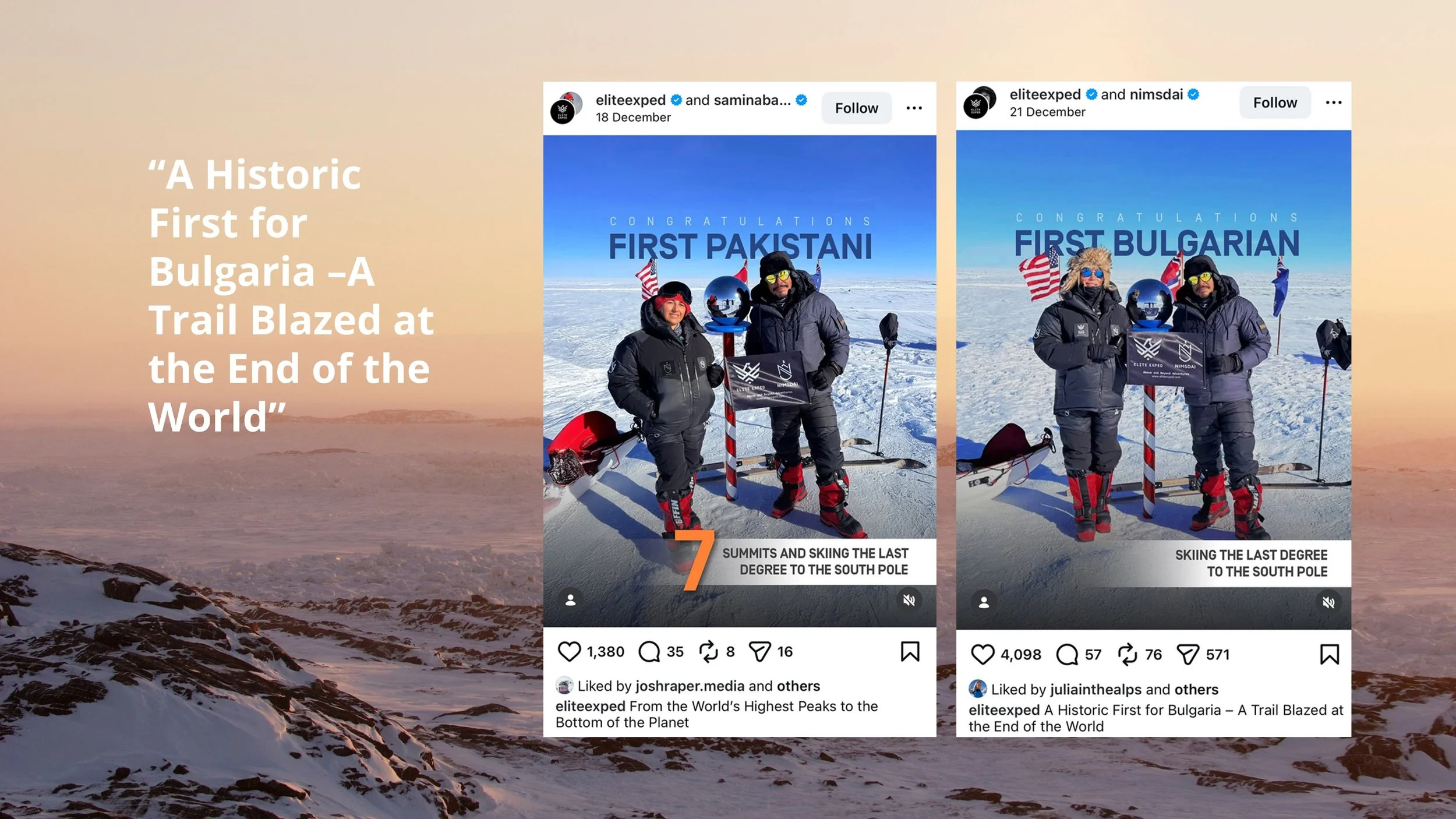
And of course, on a personal level, that’s a big achievement for those individuals. But beyond nationality, the guided journey itself is essentially the same short route that many hundreds of people have already skied before.
What surprised me is that it’s not just adventurers on social media or mainstream non-expert journalists doing this. Even organisations like National Geographic have started to blur this line.
Earlier this month, National Geographic released a new documentary series following actor Will Smith on a 100-day journey to both the North and South Poles, visiting all seven continents along the way. For the Antarctic section, British adventurer Richard Parks accompanies him, and the two of them ski a short, unspecified route to the South Pole.
One piece of coverage described Parks as “the man who’s about to break another world record at the North Pole”, referring to a planned 2027 expedition where he intends to ski to the Pole from Ellesmere Island, following the route taken by Matthew Henson and Robert Peary.
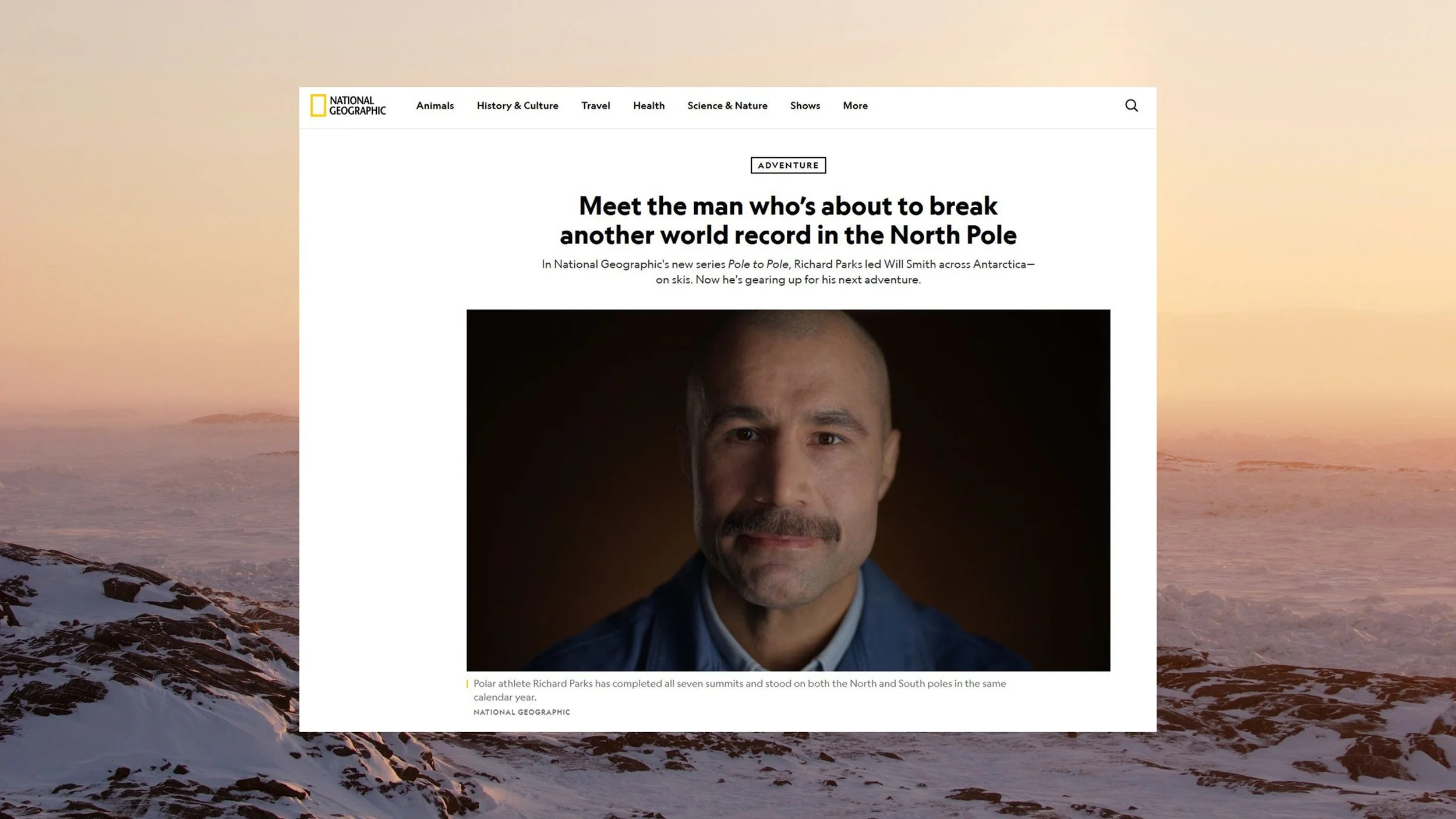
What the article didn’t mention is that this exact journey has been completed many times before, most recently by Eric Larsen and Ryan Waters in 2014. So it’s not a new world record.
So again, it’s not that these journeys are not important. But the language around them — the way they’re framed as historic firsts — often doesn’t really reflect what’s actually new, or what’s genuinely being added to the story of exploration.
And let’s not even open the can of worms about whether Peary really made the North Pole in 1909…which is coincidentally the same year this hotel was opened!
One of the main organisations who facilitate this whole “record culture” is Guinness World Records.
A lot of the records you see quoted in mainstream media are officially recognised by Guinness, and within the adventure community they’ve been criticised for a while by some folks. Not so much for getting the basic facts wrong, but for the way the records are defined in the first place. Very often they’re based on extremely narrow categories or demographic distinctions.
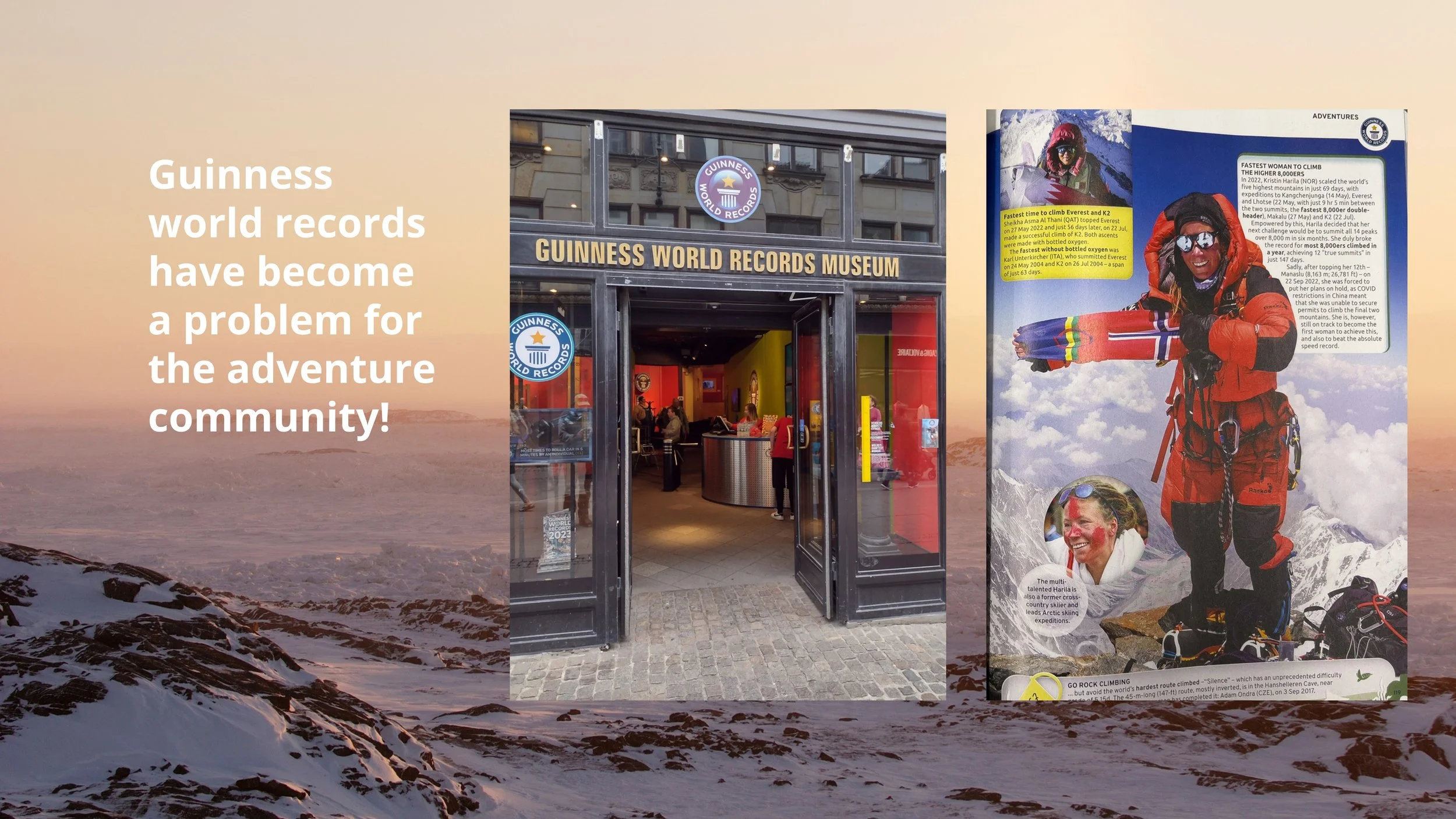
Guinness is generally good at verifying whether something can be documented. They’re much less concerned with whether it actually represents something meaningful in the bigger picture of adventure and exploration.
I wrote about this a couple of years ago for ExplorersWeb, and one thing that interested me in some reporting I came across was how the business model has changed. Since around 2008, Guinness has increasingly moved towards helping individuals and companies create records for publicity, while charging a consultancy fee to guide them through the process.
Historically, Guinness did a pretty decent job of cataloguing major milestones — first ascents of big mountains, crossings of deserts, reaching the poles, that kind of thing. Those records made sense, because they reflected genuine firsts.
But in recent years, as guided adventure tourism has made extreme environments more accessible, the organisation has started approving a huge number of adventure records that feel… slightly contrived. You end up with categories like “the fastest ascent of the three highest mountains using supplementary oxygen” — which is technically precise, but also kind of arbitrary. What about the fourth and fifth highest mountains?
And after a while it starts to feel a bit like the boy who cried wolf. If everything is a world record, then who’s actually listening anymore?
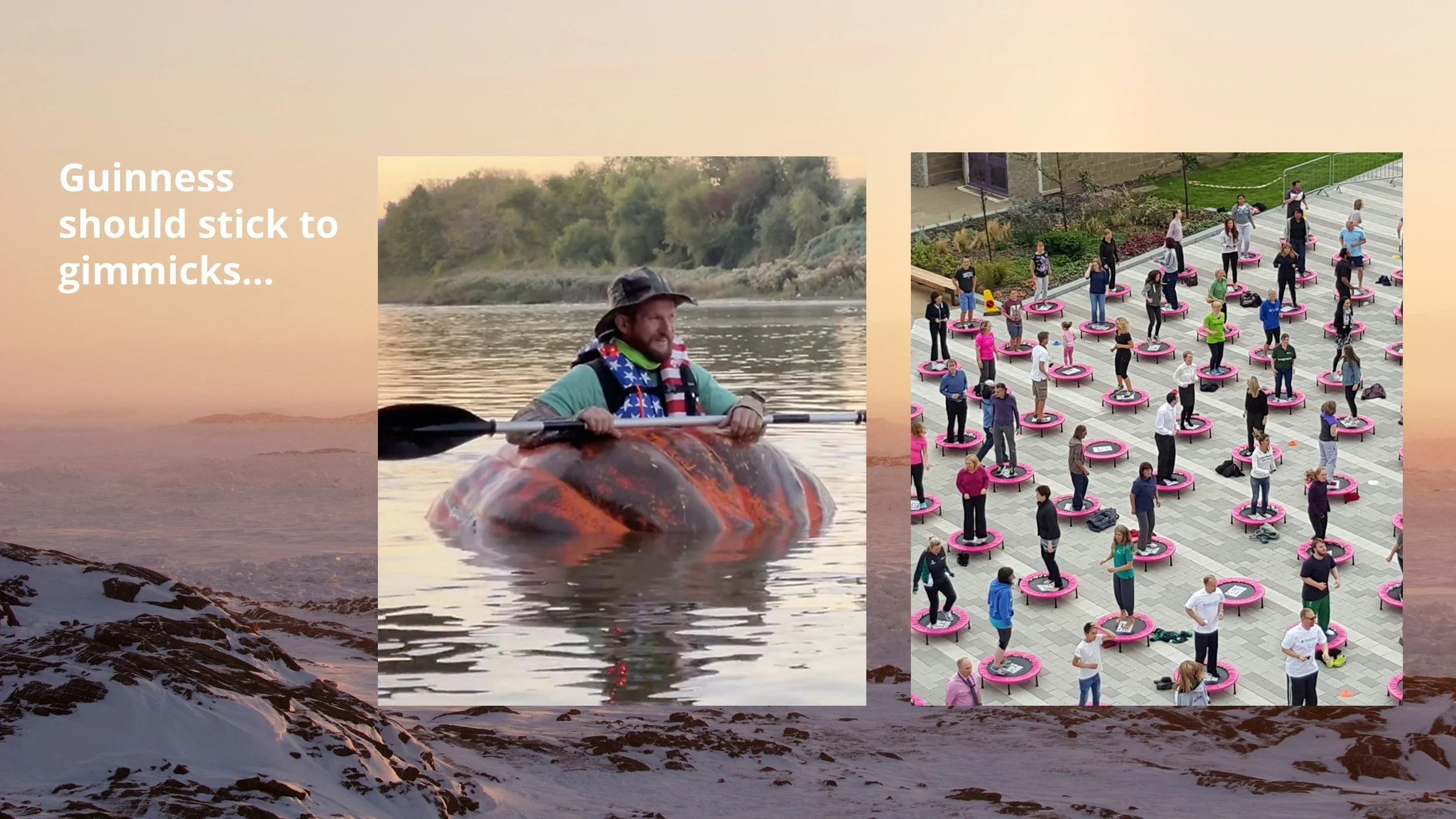
So I think it’s worth asking whether the adventure community really wants Guinness to have any meaningful role in shaping the history of adventure and exploration. Or whether it might be better if they focused on what they originally did so well — the fun, slightly silly records.
You know, things like the largest group dressed as penguins, or someone paddling across a lake in a giant pumpkin. Those records are at least honest about what they are.
Part 2 – The Solutions
Having said all of this, I think there are still huge opportunities for interesting and creative expeditions. With a bit of research and imagination, there are plenty of unique and interesting journeys still to be had.
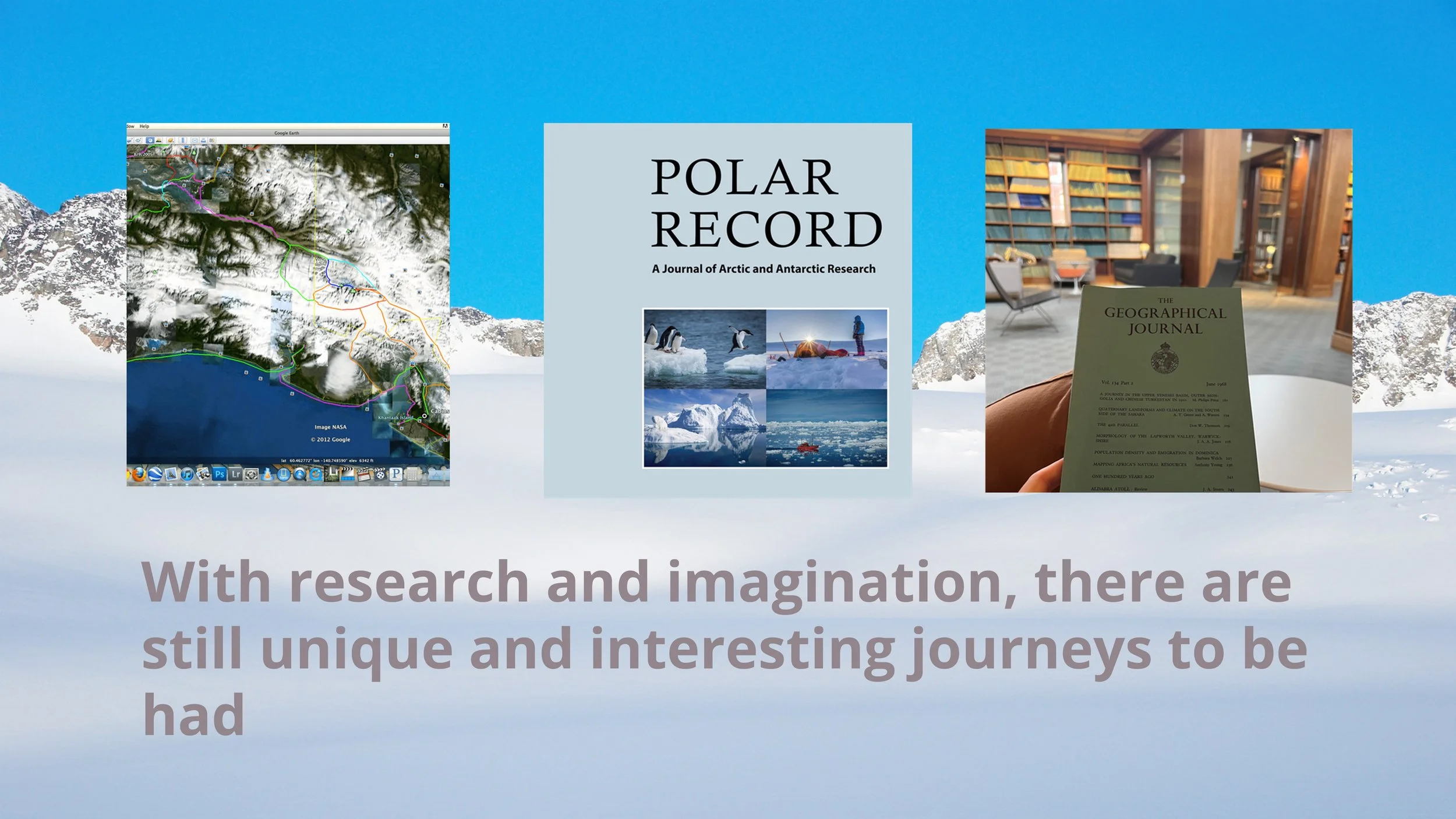
One option is to recreate historical journeys. And if we think back to those criteria — originality, remoteness, independence — that usually means looking at lesser-travelled routes, and often at lesser-known figures from the history of exploration.
One of my favourite recent examples came to mind while reading the latest book by the Canadian writer and adventurer Adam Shoalts. Shoalts has a PhD in history and has built a career around long canoe and trekking journeys across the Canadian Arctic.
In this book, he introduces a largely forgotten British explorer called Hubert Darrell. Darrell emigrated to Canada at sixteen to work on a farm in Manitoba in the late 1800’s. When news of gold in the Klondike broke, he headed north like so many others. He spent over a decade prospecting along isolated mountain streams, but never struck it rich.
What he did discover instead was a talent for exploration and map-making. He supported himself as a guide, trapper, riverboat sailor, and mail carrier between remote Arctic outposts, making extraordinary journeys alone across mountain ranges, forests, and frozen tundra.
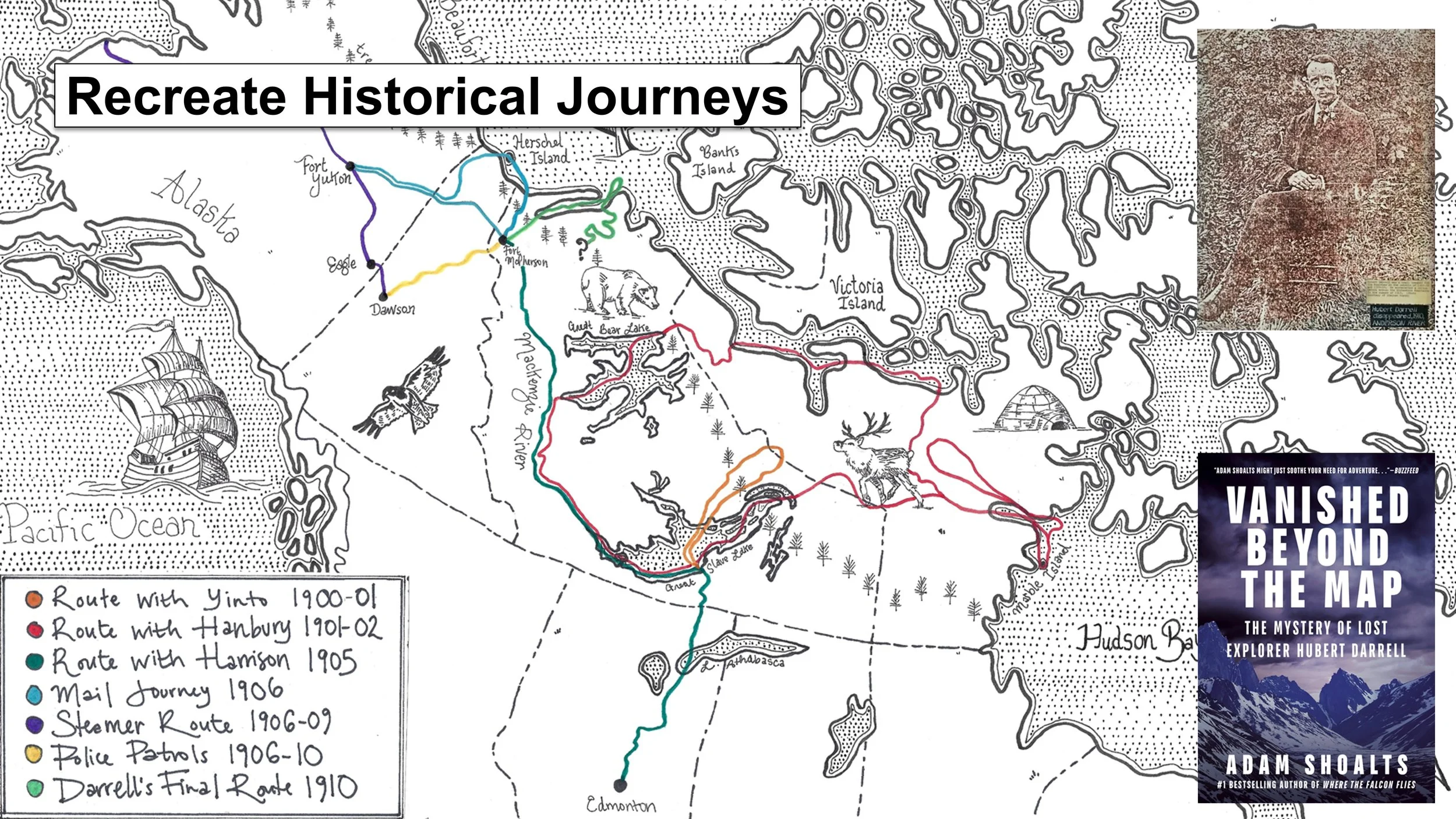
What’s particularly unusual is that Darrell often travelled without canoes or dog teams, preferring to go on foot. He navigated using his own hand-drawn maps, correcting official charts that were frequently wrong.
As you can see from the map behind me, between 1900 and 1910 he made multiple long journeys across the Northwest Territories and the Canadian Arctic. On one trip in 1906, he walked around 800 miles pulling a mail sled from Fort Macpherson to Fort Yukon, where he happened to meet Roald Amundsen along the way. Amundsen later said that with men like Darrell, “I could go to the moon.”
Now Shoalts has retraced some of Darrell’s routes, but many of them are still out there, largely untouched, and potentially fascinating summer or winter journeys for modern explorers. So that’s one idea to start with.
Sometimes myths and folklore can sometimes act as a starting point. Another recent journey that fits the historical retracing from a folklore point of view is the solo ski trip by Japanese Arctic adventurer Yasu Ogita. In the spring of 2025, Ogita set out from Siorapaluk, the world’s northernmost civilian settlement in northwest Greenland, on a roughly 400 kilometre round trip across the remote northwestern tip of the Greenland Ice Sheet to a place known as Anoritoq.
Ogita’s main goal was to reach the “Mother’s Stone,” a landmark tied to a well-known Inuit legend. The story tells of a woman who lost her son and raised a polar bear cub in his place. When the bear was later killed by a hunter who didn’t recognise it, the mother’s grief was so great that she turned into stone. Inuit hunters still visit the rock and smear it with seal blubber to honour her spirit.
What makes this journey interesting isn’t the distance on its own, but the cultural purpose behind it. Ogita wasn’t just clocking kilometres — he was making a kind of pilgrimage, following a story that’s deeply embedded in local tradition.
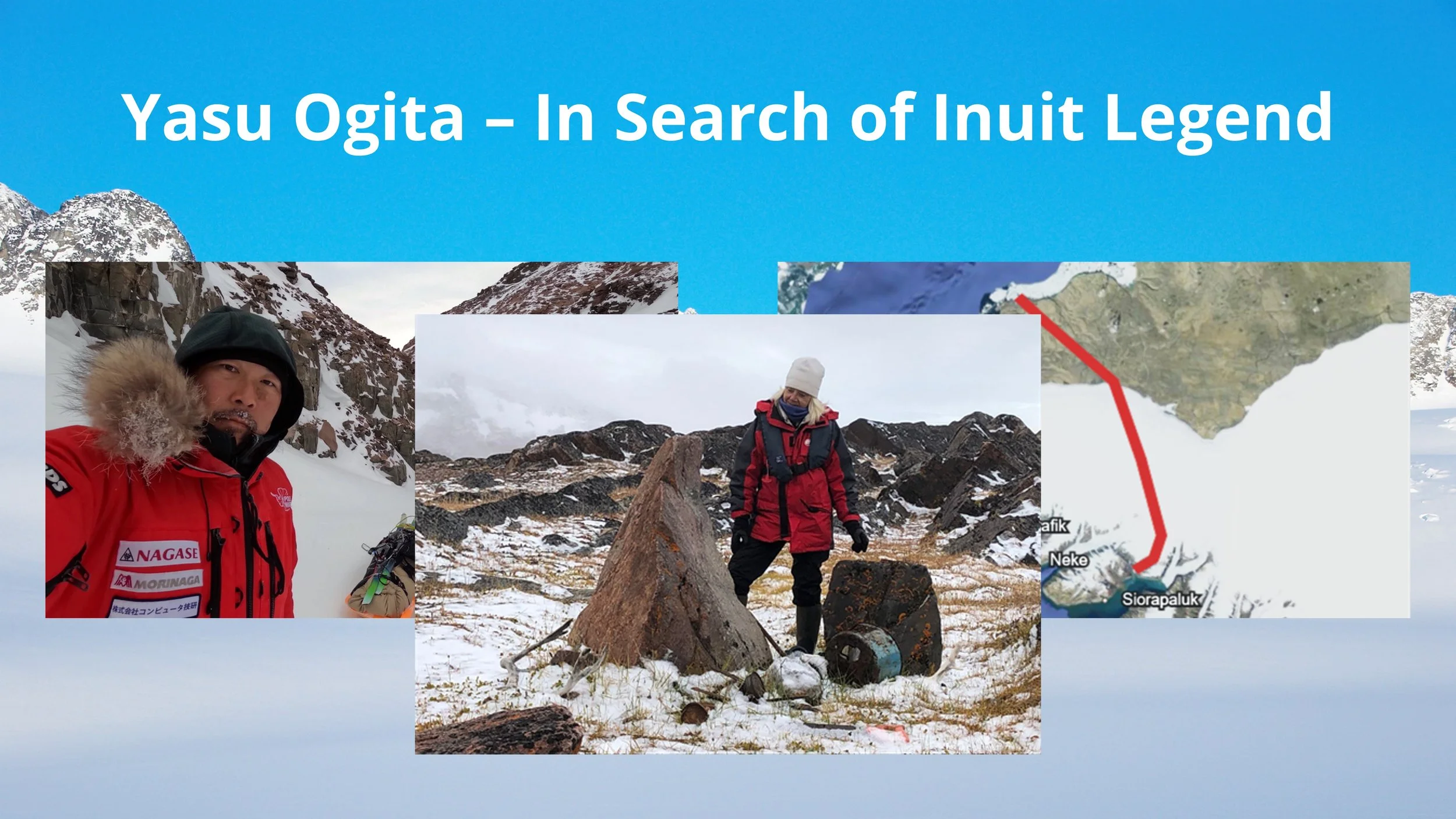
On April 29 of last year, Ogita reached the Mother’s Stone. He later reported that he had smeared the rock with seal blubber, as the hunters do.
It’s the kind of expedition that didn’t make headlines for setting a record, but it captures something deeper for me, a mix of curiosity and connection to place that feels to me just more interesting.
Of course, retracing historical journeys isn’t the only option. There’s one thing I didn’t include in my criteria, and that’s the simple draw of the landscape itself. The beauty of the place. It’s something I rarely hear polar adventurers talk about as a central reason for choosing a route, Yet when you’re actually out there, isn’t that one of the most important factors of all?
Some time on Google Earth or consulting those with a deep historical and geographical knowledge can help identify the most awe-inspiring routes.
In my case it was teaming up with ExplorersWeb editor Jerry Kobalenko who has a deep knowledge of the Canadian Arctic. Two days before the Covid-19 pandemic locked down the UK, Jerry and I were flying out to Baffin Island to attempt a 35-day sled journey along the east coast of the island. The plan was to fly into the community of Clyde River, and then ski south along the sea ice, weaving through some pretty dramatic fjord scenery to finish at the top of Baffin at Pond Inlet, where we could fly back out to Iqaluit.
The Sam Ford Fjord area in particular, which you can see in the images behind me, is especially striking. It’s a little like a giant has taken the huge cliffs of Yosemite and dropped them straight onto the Arctic coastline.
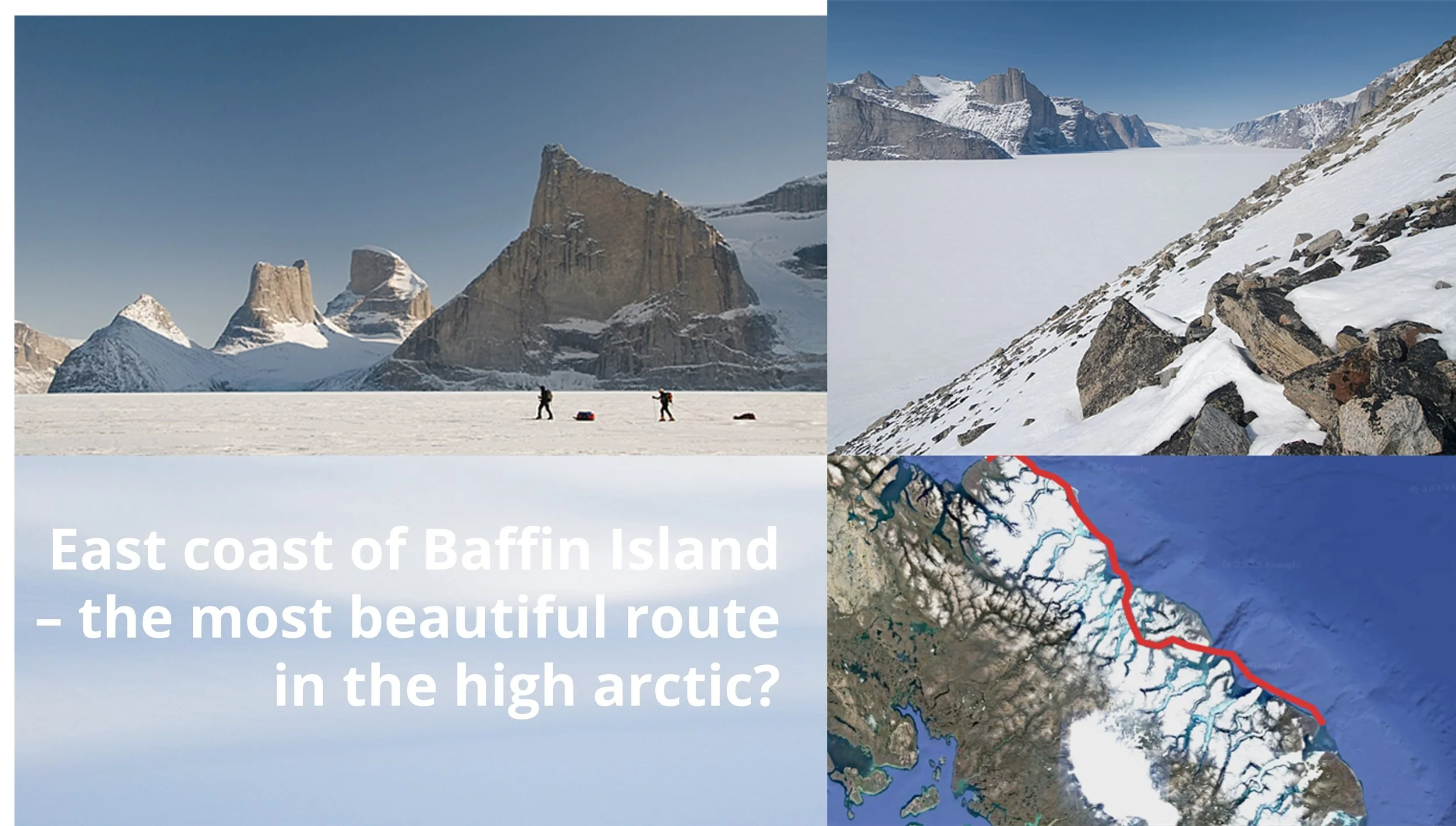
When I was helping Jerry plan the journey — and I should point out here that he was very much the master, and I was the young follower on this trip — I wasn’t able to find out exactly how many people had skied this route before. But my best guess was probably only a handful. Richard Weber had skied most of it back in 2002, but beyond that, it seemed to be not very well travelled on ski in its entirety.
It’s arguably one of the most beautiful routes in the Arctic, and it also ticked most of my earlier criteria. We were planning around 700 kilometres, including long sections of sea ice, travelling through polar bear territory, and doing the whole thing in full autonomy, without any outside support. One day I hope to do that route, but there’s an idea for some of you.
Part 3 – The Future
But what I’ve just talked about there are ideas for the average adventurer. What about the cutting edge? Where is that heading?
At the start I mentioned multi-discipline journeys, and I think that direction is very much where various adventure sports are heading. In mountaineering, for example, there are fewer truly unclimbed mountains, and those that are still unclimbed are not always the most interesting or accessible. So what some alpinists are doing now is combining disciplines to push the boundaries of what’s possible.
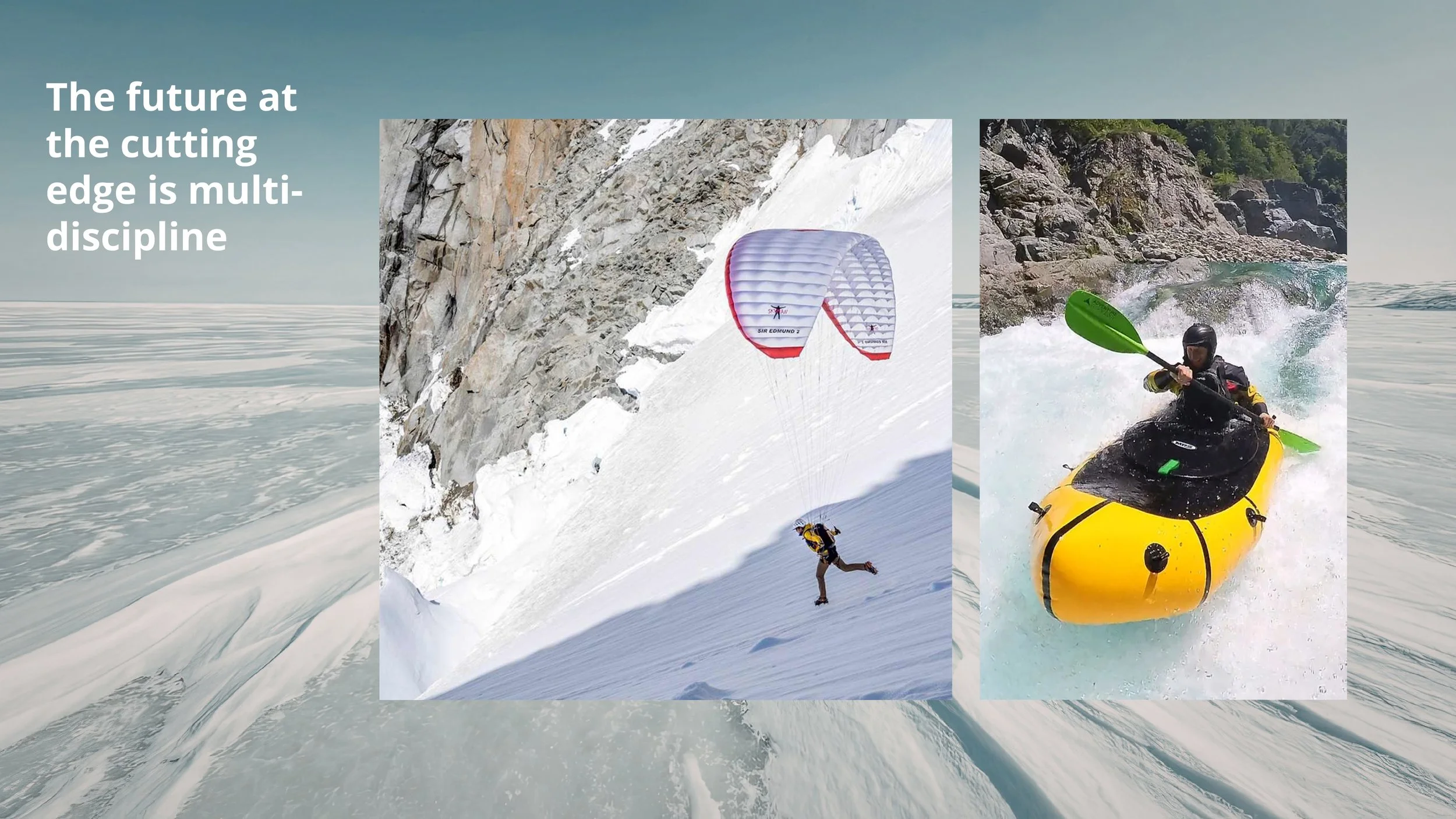
Some climbers are free-climbing hard routes and then paragliding down to reduce the objective danger of the descent. Others are paragliding from peak to peak, or even accessing peaks that were previously far more difficult to reach by traditional approaches.
A great recent example of this kind of multi-discipline approach comes from Nathan Longhurst, an American climber who set out to summit New Zealand’s 100 Greatest Peaks in one season, a list that includes some of the country’s most rugged and varied alpine terrain. Over the course of roughly 103 days, Longhurst climbed all 100 peaks and often paraglided between summits, flying off the tops or linking ridges in a way that let him traverse great distances more efficiently than by foot alone.
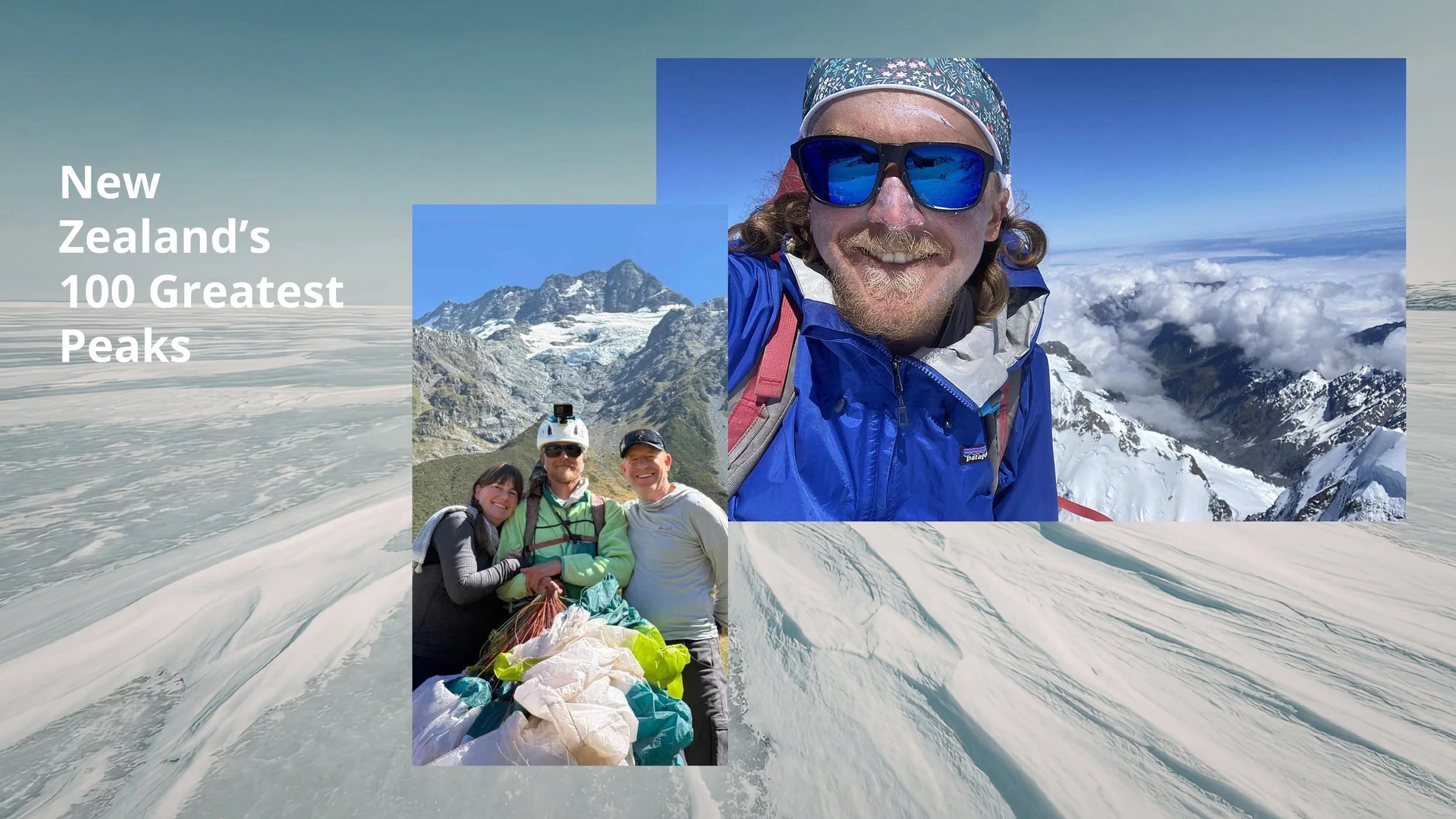
In doing so he blended mountaineering, endurance, and flight, and gave us a glimpse of how adventure can evolve when different disciplines are brought together.
In the polar world, there are a few travellers who are learning and combining multiple modes of travel and disciplines.
One of the most striking examples is the work of Erik Boomer and Sarah McNair-Landry on Baffin Island. Over multiple seasons, they’ve been designing and undertaking multi-sport expeditions that mash together sledding, kite skiing, couloir skiing, big-wall climbing, kayaking, and more in the remote fiords and mountains of the eastern Arctic.
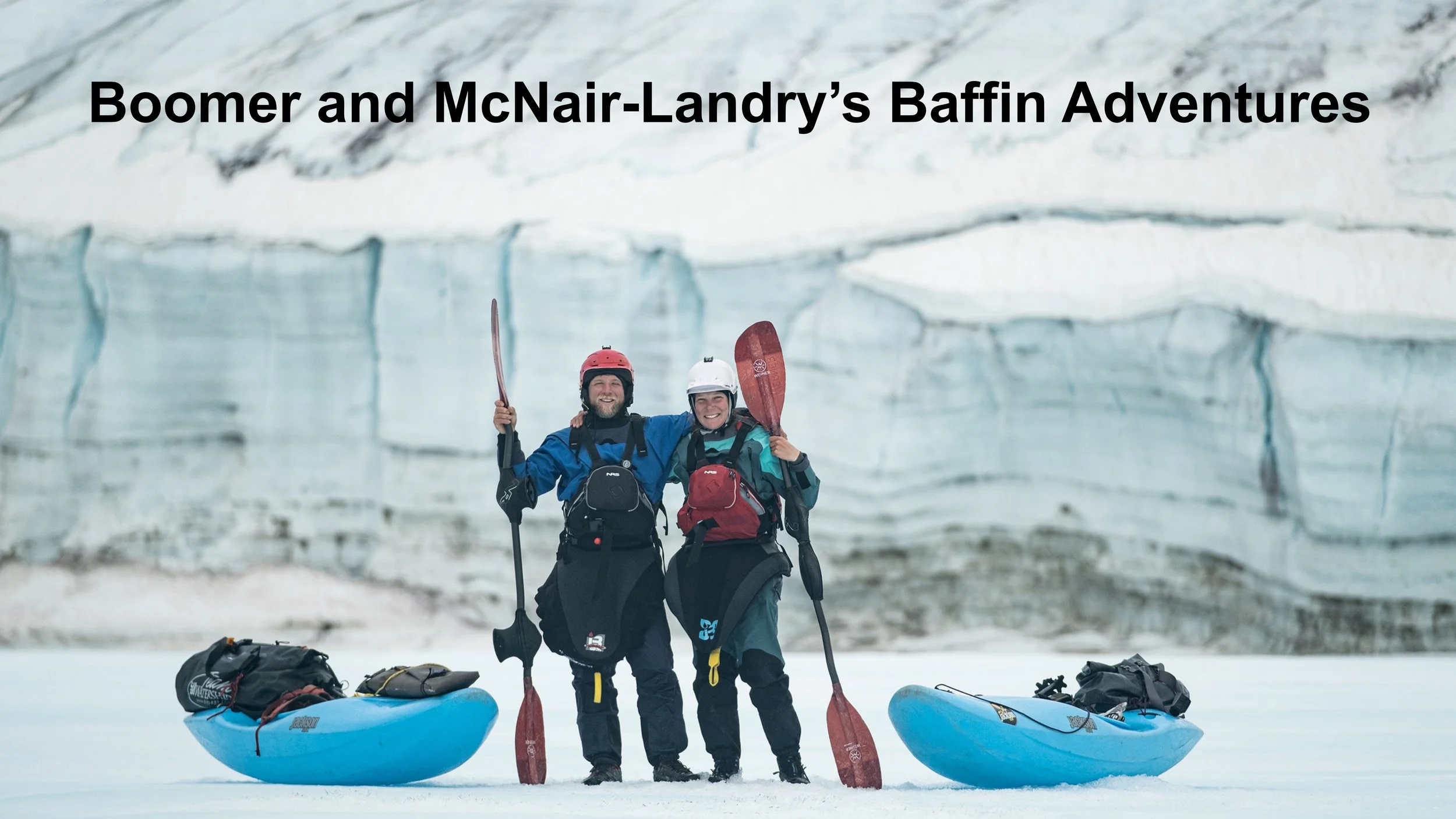
Photo: Erik Boomer
On one 25-day trip, the pair — joined by a climber — kited and skied between peaks, climbed long traditional rock routes on sea cliffs over 1,30 m high, and skied steep 40–50° couloirs like the classic Polar Star Couloir before continuing on – all under their own power.
They transition from kite skiing across sea ice, to technical rock climbing on remote cliffs, to skiing hard snow couloirs carved into the granite walls, all within the same expedition.
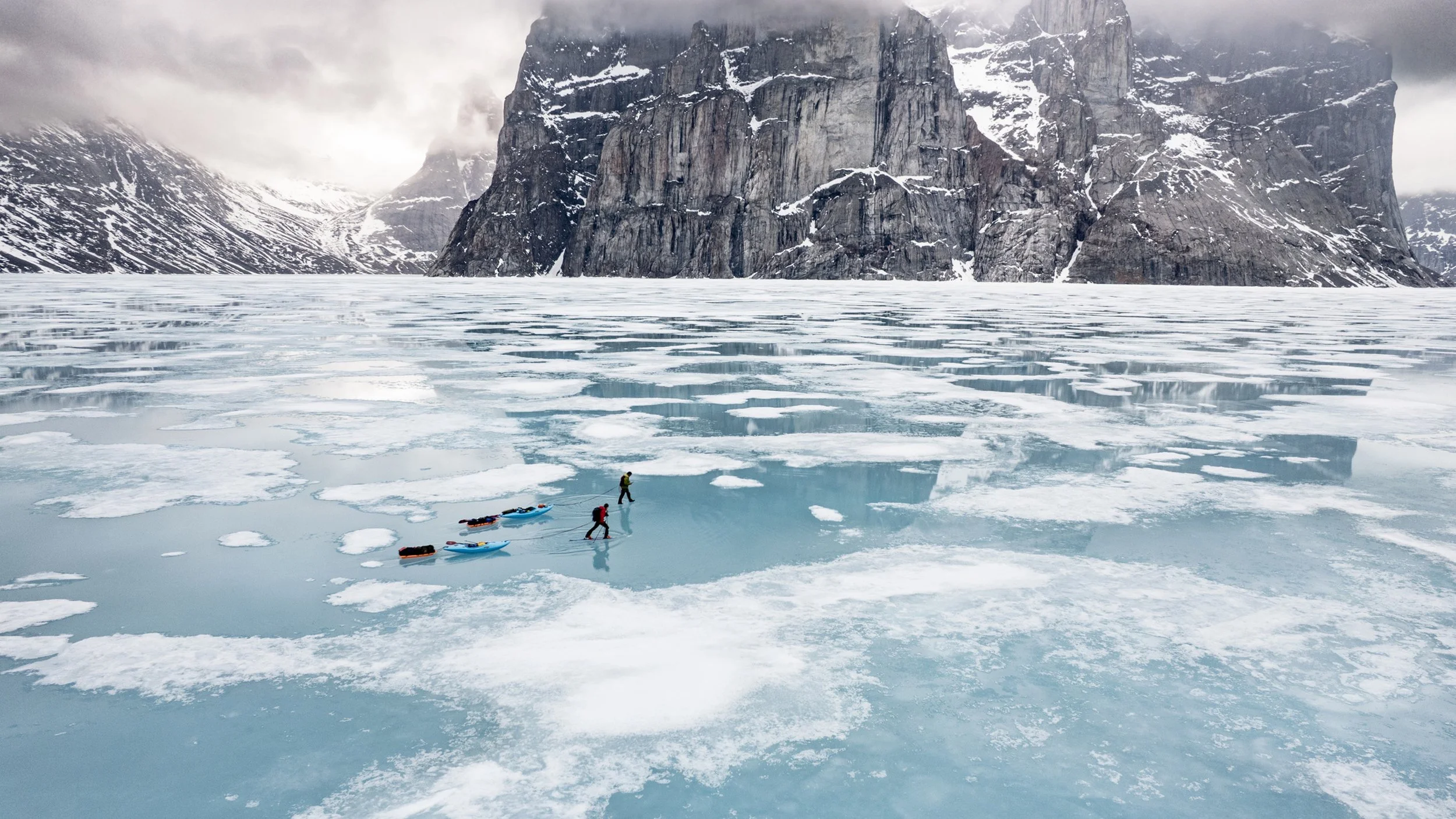
Photo: Erik Boomer
Boomer and McNair-Landry’s approach isn’t about sticking to one skill. They deliberately combine their strengths to access terrain and experiences that wouldn’t be possible through any one discipline alone.
This kind of hybrid expedition where you string together different disciplines to shape a unique overall experience, feels to me like a significant part of where the cutting edge of adventure is headed: less about single travel modes or styles and more about creative engagement with extreme places using all the skills and tools available.
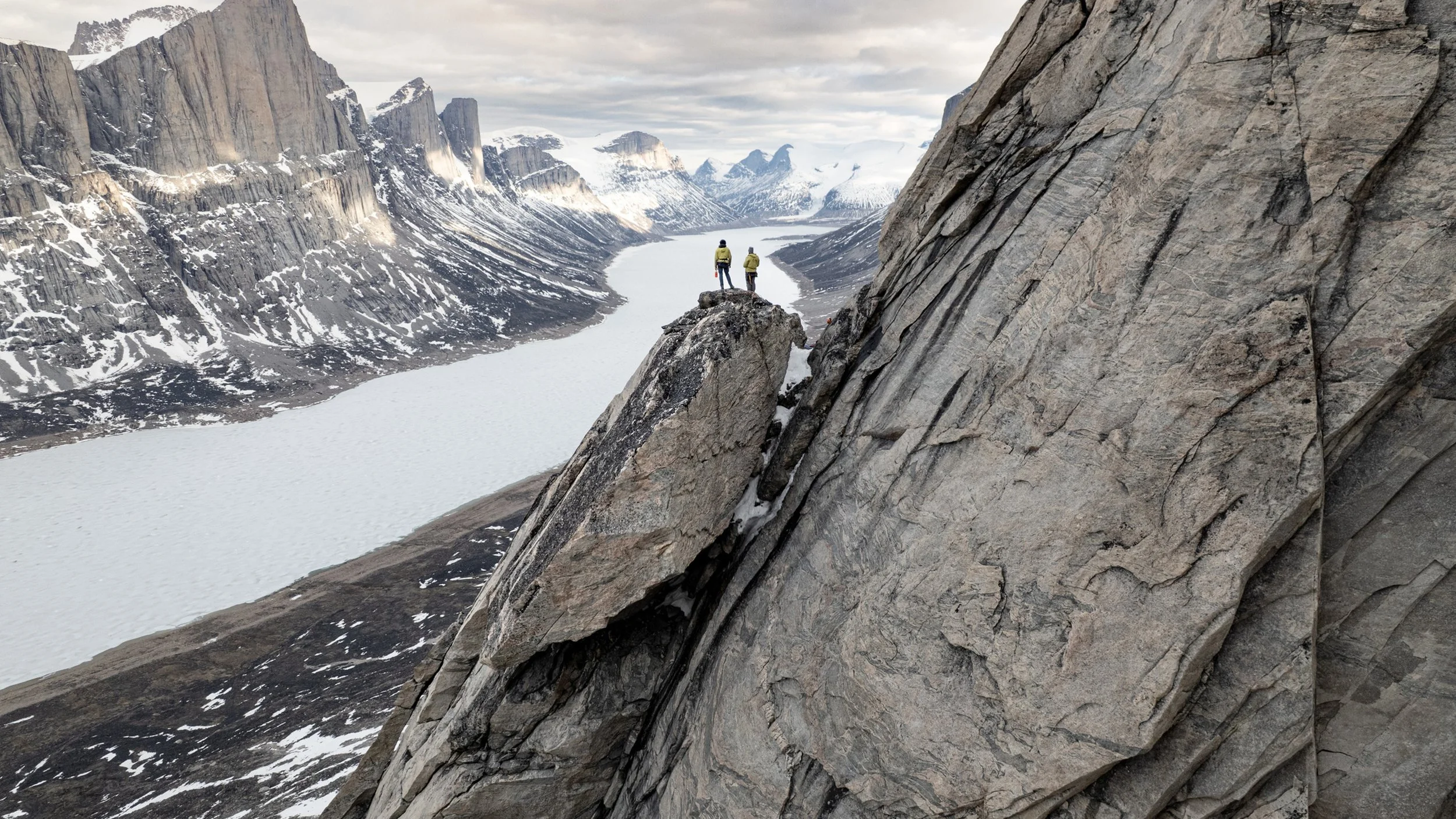
Photo: Erik Boomer
There are of course other areas where I think expeditions may move in future, particularly regarding travel and logistics with a lower carbon footprint, and greater integration of technology such as drones for rescue and resupply, however we don’t have time to cover that today.
So to wrap up now, if everything becomes a record, and every journey becomes a headline, then we risk losing the ability to recognise what’s genuinely original and interesting.
Most people in this room aren’t trying to set records, and that’s probably a good thing. But almost everyone here is I imagine trying to have meaningful experiences in extreme places.
The big question underneath this all isn’t just about records and media reporting. It’s about meaning and what we collectively choose to value and remember as a community.
The challenge isn’t simply to go further or faster to grab that record, but it is to ask ourselves how we can travel in extreme environments with a little more imagination and curiosity.